
For centuries, historians believed the story of civilization had a clear beginning. Cities rose from riverbanks. Stone monuments reached for the sky. The pyramids of Egypt stood as proof that humanity’s greatest achievements belonged to a known and carefully measured past.
But far from deserts and monuments, deep beneath the ocean’s surface, something unexpected may be challenging that certainty.
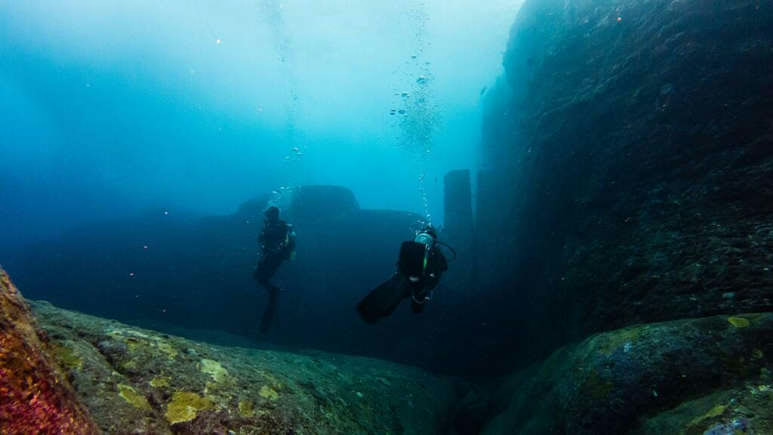
What archaeologists and researchers have encountered beneath the waters near Cuba has sparked global curiosity, cautious excitement, and heated debate. Some believe it could be the remains of a lost city—one that may predate the Egyptian pyramids themselves.
And if that is true, the implications are staggering.
A Discovery That Was Never Meant to Happen
The discovery did not begin with archaeologists searching for ancient ruins. It began with technology.
In the early 2000s, marine engineers were conducting a routine survey of the ocean floor near Cuba’s western coastline. Their work was meant to map geological features and identify potential shipwrecks. Ancient history was not part of the plan.
Then the sonar images appeared.
The equipment revealed large, geometric shapes resting more than 2,000 feet beneath the ocean’s surface. Straight lines. Angled corners. Massive stone blocks arranged in patterns that did not look random.
At first, the team thought the instruments must be malfunctioning.
But the images persisted.
What they were seeing did not resemble coral reefs or natural rock formations. It looked organized. Deliberate. Structured.
And that was when the questions began.
Shapes That Shouldn’t Exist
As the sonar scans became clearer, the formations appeared increasingly complex. Some stones seemed stacked. Others appeared aligned in ways that suggested walls or platforms. A few formations even resembled pyramidal shapes.
The depth alone made the discovery unsettling.
At more than half a mile underwater, the area would have been dry land only if it dated back thousands—possibly tens of thousands—of years. Sea levels simply had not been that low in recorded human history.
Yet the shapes looked unmistakably intentional.
Researchers were careful not to jump to conclusions. Still, the possibility was impossible to ignore. If these structures were man-made, then they belonged to a civilization far older than any previously known in the region.
Possibly older than the pyramids.
A City Lost to the Sea
The idea of a submerged city immediately captured public imagination. Throughout history, coastlines had shifted. Entire settlements were known to have been swallowed by rising seas after the last Ice Age.
But this was different.
This site was massive. Spread across a wide area. Too large to be a single structure. Too organized to be accidental.
Some researchers described it as resembling an urban layout—open areas that could have been plazas, rows that looked like roads, and clusters of stone blocks arranged with purpose.
If correct, it suggested not just a settlement, but a city.
And cities require planning.
They require cooperation.
They require a level of societal organization that historians had never associated with such a distant past.
Older Than the Pyramids
The pyramids of Giza, built roughly 4,500 years ago, are often viewed as the starting point of monumental architecture. They represent a leap in human engineering, coordination, and vision.
But the underwater structures off Cuba challenge that timeline.
Based on their depth, some experts suggested the formations could be at least 6,000 years old—possibly far older. That would place them before Egypt’s most iconic structures, before writing systems, before what textbooks describe as the rise of complex civilization.
Such a conclusion would force historians to reconsider long-held assumptions.
Had humanity developed advanced societies earlier than believed?
Had entire cultures existed, flourished, and disappeared without leaving traces on land?
Or was this something else entirely?
Excitement Meets Skepticism
Not everyone was convinced.
Geologists quickly pointed out that nature can be deceptive. Underwater pressure, seismic activity, and erosion can sometimes create formations that appear geometric.
Straight lines do occur in nature. Angles can form. Patterns can emerge without human involvement.
Without physical samples, tools, or artifacts, declaring the site a city would be premature.
Even the researchers who first identified the formations urged caution. They described the site as “intriguing” and “unusual,” but avoided definitive claims.
At such depths, direct exploration was nearly impossible. Sending submersibles would require significant funding, government approval, and advanced technology.
For now, the evidence existed mainly as images on screens.
Compelling—but incomplete.
Why the Site Remains Unexplored
One of the greatest frustrations surrounding the discovery is how little follow-up exploration has occurred.
The reasons are numerous.
First, the depth makes exploration extremely expensive. Deep-sea missions require specialized vehicles capable of withstanding immense pressure.
Second, the site lies within Cuban territorial waters, where permits and international cooperation are difficult to secure.
Third, scientific funding is limited. Without clear proof of human construction, securing financial support for a full expedition has proven challenging.
As a result, the site remains largely untouched.
Waiting.
The Internet Takes Notice
As news of the discovery spread, online speculation exploded.
Some hailed it as proof that human history was far older and more complex than previously taught. Others linked it to legendary lost civilizations spoken of in ancient texts.
The idea of Atlantis resurfaced, despite researchers repeatedly distancing themselves from such claims.
Social media amplified every detail, every image, every theory.
Yet amid the noise, scientists maintained a careful stance. Extraordinary claims require extraordinary evidence.
And evidence, for now, remained elusive.
A Pattern of Surprising Discoveries
The underwater site off Cuba is not the only discovery to challenge traditional timelines.
In recent decades, archaeologists have uncovered ancient cities hidden beneath jungles, deserts, and farmland. Technologies like LiDAR have revealed massive settlements previously invisible to the naked eye.
Sites once dismissed as myth or exaggeration have proven real.
Each discovery has pushed civilization’s origins further back.
This context makes the Cuban site harder to dismiss outright.
History, it seems, has a habit of surprising those who think it is already fully written.
What If It’s Real?
If the underwater formations are eventually confirmed to be man-made, the consequences would be profound.
It would suggest that humans built large, organized settlements long before historians believed possible.
It would imply that rising sea levels erased entire chapters of civilization, leaving little behind but submerged stone.
And it would raise unsettling questions about how much of humanity’s story remains hidden beneath oceans and shifting landscapes.
Civilization, in this view, would not be a straight line of progress—but a series of rises, collapses, and forgotten beginnings.
A Mystery That Refuses to Fade
Years have passed since the discovery, yet interest has not diminished. If anything, it has grown.
Every advancement in underwater exploration technology renews hope that the site might one day be properly examined.
Every new ancient discovery elsewhere in the world adds credibility to the idea that early societies were more capable than once believed.
For now, the lost city remains silent beneath the waves.
Unconfirmed.
Unexplained.
Unforgotten.
Waiting for the Truth
The ocean has always been a keeper of secrets. Entire ships, cities, and civilizations have vanished into its depths, preserved in darkness.
Whether the Cuban site proves to be a geological illusion or one of the most important archaeological discoveries of all time, it has already accomplished something remarkable.
It has reminded the world that history is not finished.
That the past is deeper than deserts and ruins.
And that somewhere beneath the surface, answers may still be waiting.