
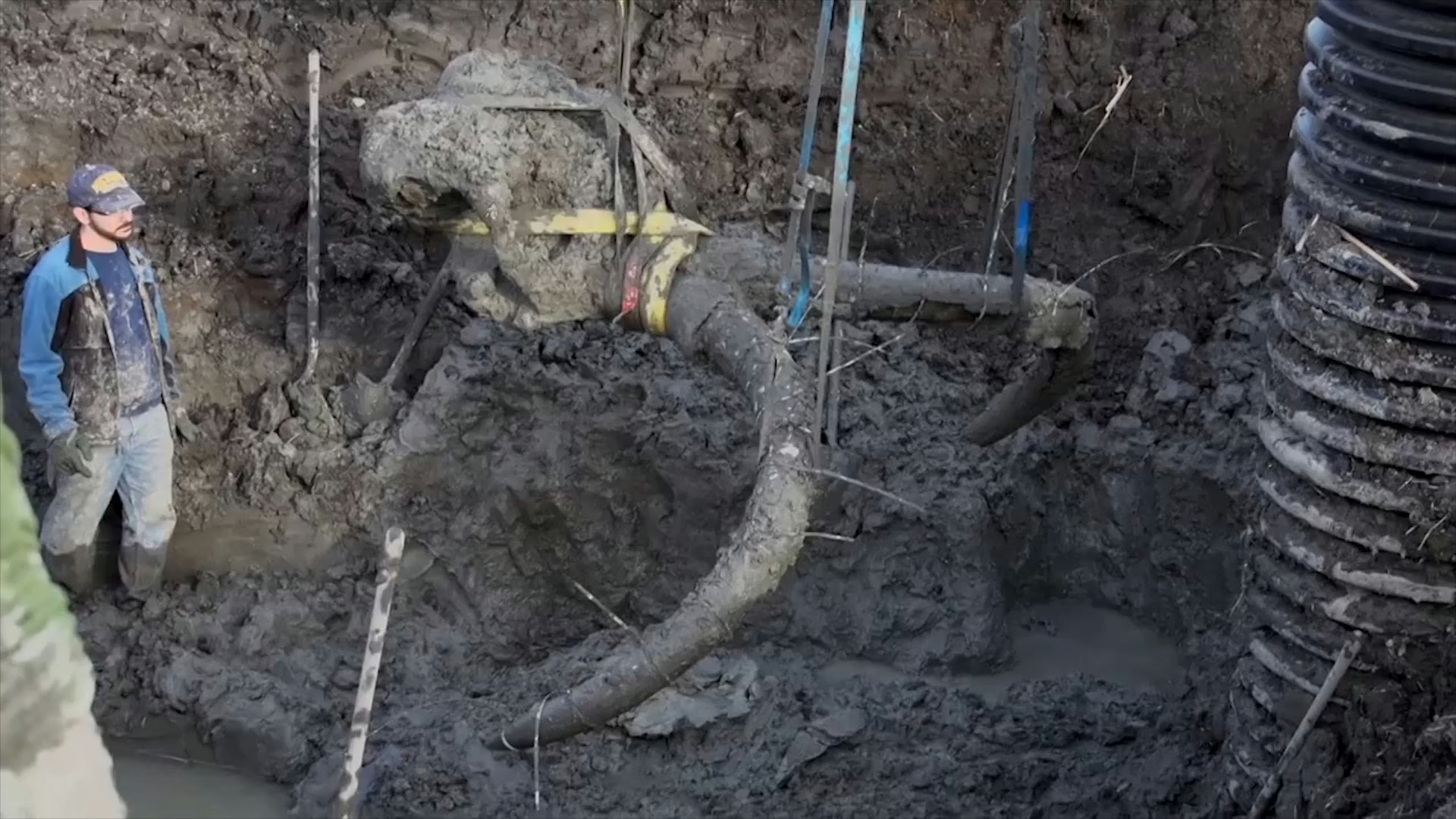
On an ordinary October morning in rural Michigan, a farmer set out to do an ordinary job. By nightfall, his field would be transformed into one of the most intriguing archaeological sites in the Great Lakes region—an accidental doorway into a world more than 15,000 years old.
This is the story of persistence, curiosity, and the haunting reminder that history doesn’t always lie in museums. Sometimes, it waits patiently beneath our feet.
A Chilly Morning Outside Ann Arbor
The land outside Ann Arbor is flat and forgiving, stitched together by long rows of wheat and corn that ripple under gray Midwestern skies. On that morning, the ground was soaked from recent rains, and farmer James Bristle knew he needed to install a drainage system before the field became unusable.
Just after dawn, Bristle climbed into his backhoe. Mud piled up with each scoop—nothing unusual—until around mid-morning, when the metal bucket struck something solid.
It wasn’t rock.
It wasn’t wood.
Whatever it was, it stopped the machine cold.
“That’s Not a Fence Post”
Curious, Bristle climbed down and began clearing away the mud by hand. Slowly, a dark, curved object emerged—smooth, massive, and unmistakably organic.
At first, he thought it might be the remains of a cow or horse, buried decades earlier. But the size didn’t make sense. The curve didn’t make sense.
The object was nearly three feet long.
It was a tusk.
When Bristle’s neighbor joined him, neither man spoke for a long moment. The realization came quietly and heavily: this was not just old—it was ancient.
Scientists Arrive, Time Runs Short
A call went out to the University of Michigan, and within hours, paleontologist Dr. Daniel Fisher and a team of graduate students arrived at the field.
Bristle gave them one day.
That single day changed everything.
Working carefully with trowels and gloved hands, the team uncovered vertebrae still aligned in sequence, as if the animal had fallen and never moved again. A massive skull followed, fractured by time but unmistakable. Then the second tusk—curled inward like a frozen serpent.
By dusk, under portable lights and clouds of visible breath, nearly 20% of a woolly mammoth had been exposed.
But what stopped the scientists cold wasn’t just what they found.
It was how they found it.
A Skeleton That Told a Story
The bones were not scattered, as nature often leaves them.
- Vertebrae remained aligned
- Ribs arched in deliberate curves
- Large rounded boulders rested on specific parts of the skeleton
These stones were too heavy to have shifted naturally. They had been placed.
Then came the most telling clue:
A small stone flake, sharpened on one edge, unmistakably shaped by human hands.
The mammoth had not simply died.
It had been used.
The Pond Storage Theory
Dr. Fisher had long discussed a controversial idea known as the pond storage theory.
During the late Ice Age, early humans sometimes killed animals so massive that preserving the meat became a logistical challenge. One proposed solution was ingenious: butcher the mammoth, then submerge parts of it in cold, still water—weighing it down with stones. Nature became a refrigerator.
The Michigan find fit the theory almost perfectly.
- Carefully arranged bones
- Strategic stone placement
- Evidence of still, shallow water
- A human-made tool
Standing in the cold wind, Bristle realized he hadn’t uncovered just a fossil.
He had uncovered a prehistoric food cache.
Returning to the Field
Two years later, in 2017, Bristle allowed the team to return.
They dug deeper.
What they found erased lingering doubts.
Nearly 40 additional bone fragments surfaced—molars, ribs, pelvic pieces. One bone, when radiocarbon dated, came back more than 15,000 years old, predating any known permanent human settlement in the Great Lakes region.
Sediment samples revealed fungal spores consistent with cold, still water. Pollen grains painted a picture of a long-lost landscape—spruce and fir forests where cornfields now grow.
Nothing about the site suggested randomness.
Everything suggested intention.
A Silent Human Presence
No carvings.
No names.
No footprints left behind.
Just a flake of stone and a mammoth carefully laid to rest beneath boulders and mud.
Who were they?
How many hunters stood in that cold, ancient water?
Did they return for the meat—or were they driven away by weather, predators, or time itself?
History offers no answers.
Only silence.
A Field That Will Never Be the Same
For James Bristle, the land has changed forever.
What was once just another patch of farmland is now a reminder that the past is not distant—it’s layered. Beneath tractors and drainage pipes lie stories of survival, ingenuity, and lives lived long before written memory.
Every time Bristle passes that spot, the questions return:
Who stood here before me?
What happened on this land in the cold and the dark?
How many more stories are buried below, waiting for a blade of steel to strike something solid?
Sometimes, history doesn’t announce itself.
Sometimes, it waits patiently—
until someone refuses to give up digging.